
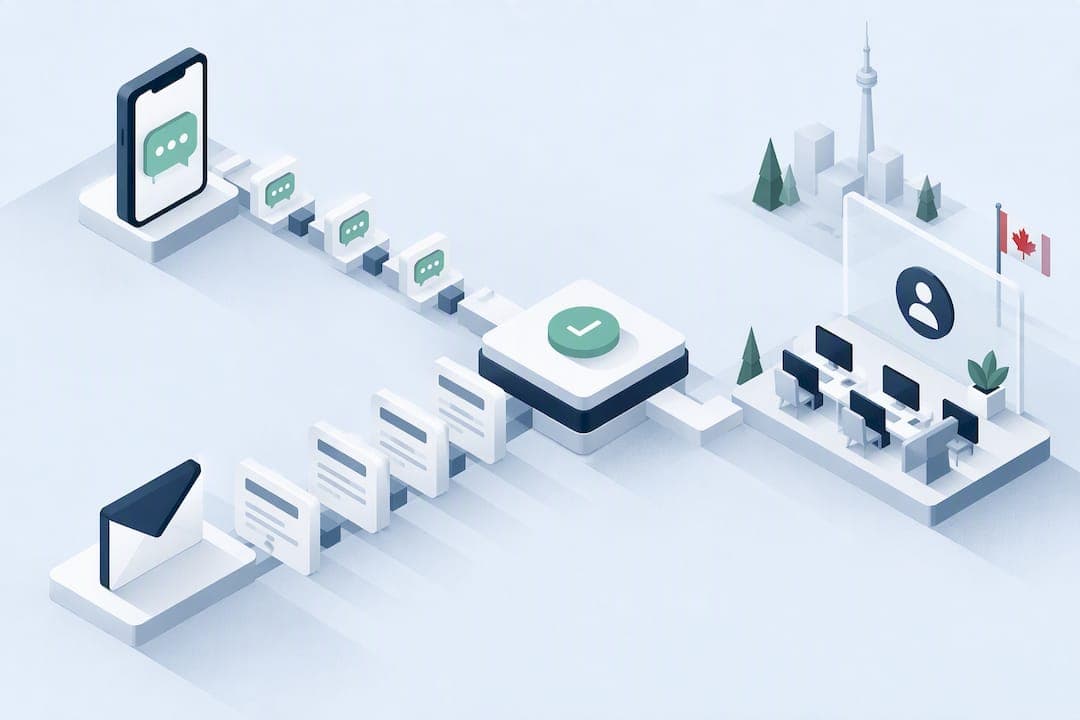
SMS wins for urgent, time-sensitive messages, appointment confirmations, and anything that needs a reply within minutes. Email wins for storytelling, nurture sequences, and content that needs more than 160 characters to land. SMS response rates dramatically outpace email open rates, but permissioned email lists in Canada still see open rates in a moderate to high range, and Canada's anti-spam law (CASL) governs both channels. The highest-performing service businesses use both, coordinated through a platform like Gravun.
TL;DR:
- SMS provides immediate engagement, with most responses occurring within ten minutes, making it ideal for urgent notifications like appointment reminders or flash sales.
- Permissioned email lists in Canada maintain open rates between 30% and 50%, especially when using automation, which outperforms manual campaigns.
- Automated, trigger-based messaging across both channels significantly boosts conversion rates compared to one-time broadcasts.
- Running SMS and email through a unified platform simplifies compliance, consent tracking, and attribution, reducing operational complexity and audit risks.
- Most businesses should use SMS for time-sensitive communication and email for detailed content, scaling each based on consent and cost considerations.
Table of Contents
- SMS vs Email Marketing: A Side-by-Side Breakdown
- SMS vs Email Effectiveness: What the Benchmarks Actually Show
- Consent and Compliance Requirements for SMS and Email Under CASL
- Which Channel to Choose for Each Campaign Type
- Building a Combined SMS and Email Workflow
- Why a Single Workspace Makes Compliant Multi-Channel Campaigns Easier
- A Practitioner's Take on Choosing Between SMS and Email
- Get SMS and Email Working Together With Gravun
- Sources
- FAQ
SMS vs Email Marketing: A Side-by-Side Breakdown
Marketers keep asking the wrong question. It is not "SMS or email" but "which job does each one do better?" The two channels solve different problems, and treating them as competitors instead of teammates is the single most common strategic mistake in business messaging today.
Visibility and immediacy separate the two channels more than any other factor. A text message gets read within minutes of arriving, often while the recipient is still holding the phone that delivered it. Email sits in an inbox competing with dozens of other messages, and even a strong subject line has to survive a scroll past promotions, newsletters, and internal memos before it earns a click.
Message complexity flips the advantage the other way. Email supports logos, product photography, embedded video links, multi-paragraph explanations, and calls to action stacked in sequence. SMS caps out around 160 characters before it splits into multiple segments, which makes it a poor fit for anything beyond a confirmation, a reminder, or a short offer with a link.
Cost and scale tell a more nuanced story. Email marketing platforms typically charge based on list size or send volume, and the marginal cost of emailing 10,000 more contacts is close to zero on most plans. SMS carries a real per-message cost from the carrier layer, which means a text blast to a large list gets expensive fast. That cost structure naturally pushes SMS toward smaller, higher-intent segments rather than mass broadcasts.
Audience preference and permission realities also diverge sharply between the two:
- Email lists tend to be larger because sign-up friction is lower and consent can be gathered through simple opt-in forms.
- SMS lists are smaller but higher-intent, since giving out a phone number feels like a bigger commitment than an email address.
- Consent rules under CASL apply to both, but SMS carries slightly higher practical risk because recipients notice unwanted texts faster than unwanted email.
When it comes to measurement, the two channels reward different KPIs:
- Email — track open rate, click-through rate, and conversion rate per campaign segment.
- SMS — track response rate, click-through rate on shortened links, and opt-out rate as an early warning signal.
- Combined campaigns — track incremental lift by comparing an SMS-plus-email cohort against an email-only holdout group.
The channel that wins depends entirely on what the campaign needs to accomplish, not which one has better headline stats.
SMS vs Email Effectiveness: What the Benchmarks Actually Show
The gap in engagement speed between these two channels is not subtle. Industry compilations tracking SMS marketing statistics consistently show SMS response and open rates substantially outpacing typical email open and click rates, with most texts read within three minutes of delivery. That kind of immediacy makes SMS the natural choice for anything with a countdown clock attached to it: appointment reminders, delivery windows, flash sales closing in hours.
Email is not losing ground the way some marketers assume. The State of Email Marketing in Canada 2026 report from Cyberimpact shows permissioned lists commonly reaching open rates between 30% and 50%, a number that surprises marketers who assume inbox fatigue has killed the channel. Consent-driven lists produce cleaner, more engaged audiences, even when the total reach is smaller than an unfiltered blast would achieve.

Statistic to remember: Automation is where the real revenue efficiency shows up. Omnisend's research found that automated emails generated 27% of total email revenue while representing just 2.1% of total sends, with automated emails converting at 31.23% compared to 9.24% for scheduled sends. That gap is not a small edge. It means a business sending fewer, smarter, trigger-based messages consistently outperforms one blasting its full list on a fixed schedule.
A few patterns hold up across the available data:
- SMS wins on speed: most replies come within the first ten minutes of send.
- Email wins on depth: a single message can carry a full offer, images, and multiple calls to action.
- Automated sequences beat one-off blasts on both channels, often by a wide margin in click-to-conversion rate.
- Response latency for SMS makes it the better tool for anything requiring same-day action, while email's longer conversion window suits nurture campaigns spread across days or weeks.
The practical takeaway: benchmark your own campaigns against these figures, but expect automation, not raw send volume, to be the bigger lever.
Consent and Compliance Requirements for SMS and Email Under CASL
Every commercial message sent by a Canadian business, whether by text or by email, falls under Canada's Anti-Spam Legislation. CASL rests on three requirements: you need consent (express or implied), you need to identify who is sending the message, and you need to provide a working unsubscribe mechanism. Miss any one of the three and the message is non-compliant, regardless of how good the offer inside it is.
The CRTC's guidance on CASL draws a clear line between express consent (a customer explicitly opted in) and implied consent (an existing business relationship that permits messaging for a limited window). That implied consent window does not last forever, and one of the most common compliance traps is marketers who keep messaging a contact based on a business relationship that expired months ago.
Watch for these recurring mistakes:
- Relying on stale implied consent instead of refreshing it with an explicit opt-in.
- Mixing promotional content into a transactional message, which can change how the message is classified under CASL.
- Sending SMS campaigns without a clear sender identity or a working "reply STOP to unsubscribe" mechanism.
- Failing to keep records that prove when and how consent was collected.
Recordkeeping is where enforcement actually bites. An auditable consent trail, meaning a timestamp, the source of the opt-in, the exact form or checkbox language used, and where it lives in the contact record, is far more defensible than a simple "consent: yes" flag sitting in a spreadsheet. CASL enforcement has measurably reduced spam originating from Canadian organizations, and marketers who keep clean, permission-based lists report the byproduct is better engagement, not just lower risk.
Pro Tip: Treat SMS consent as higher-risk than email consent. A recipient notices an unwanted text within seconds, and opt-outs spike fast when texting feels intrusive. Audit your SMS consent list every quarter, not just once at signup.
Which Channel to Choose for Each Campaign Type
Four factors decide the channel before you write a single word of copy: urgency, message complexity, expected response time, and audience consent status. A fifth factor, cost per contact, decides how far you can scale it. Run through this checklist before every campaign:
- Does this message need action within the hour, or can it wait a day?
- Does the content need images, long copy, or multiple links?
- Do you have explicit opt-in for SMS, or only email consent?
- What's the per-contact cost at your current list size?
Real campaign patterns make the framework concrete:
- Appointment reminders — SMS for the day-of nudge, paired with a confirmation email that carries the full appointment details and a reschedule link.
- Flash sales — Email to announce the offer with full visuals and terms, SMS as a same-day reminder a few hours before the sale closes.
- Onboarding sequences — A multi-email series carrying the bulk of the education, with SMS nudges reserved for milestones the customer might otherwise miss, like an unfinished setup step.
- Service update or delay notices — SMS first, since customers need to know now, with an email follow-up for the fuller explanation.
Budget-conscious teams should pilot SMS on a narrow, high-intent segment first, recent bookers or repeat customers, before rolling it out to a full list. That approach limits the per-message cost exposure while you measure whether the incremental response actually justifies the spend. Once a segment shows strong reply rates and low opt-outs, scaling the same pattern to adjacent segments is a much safer bet than launching SMS to an entire database on day one.
Building a Combined SMS and Email Workflow
The real advantage shows up when SMS and email work as a single sequence instead of two separate campaigns fighting for attention. A cart-abandonment flow might send an email within an hour, follow with a second email at 24 hours, and drop in an SMS nudge only if neither email gets opened. That kind of fallback logic keeps the higher-cost channel in reserve for the contacts who need the extra push.
Strong automation triggers to build around:
- Cart or booking abandonment, escalating from email to SMS if there's no response within a set window.
- Appointment confirmations, sent by SMS immediately and backed by a detailed email receipt.
- Inactivity re-engagement, where a dormant contact gets an email first and an SMS only if they've shown recent purchase behavior.
Omnisend's data shows automated cross-channel messages convert more efficiently than scheduled, one-size-fits-all sends, which makes trigger-based sequencing worth the setup time even for smaller teams.
Attribution gets tricky once two channels touch the same customer journey. Run holdout tests: split a segment into an SMS-plus-email group and an email-only control, then compare conversion rates over the same window. That is the only reliable way to isolate how much SMS is actually adding, rather than assuming it.
Pro Tip: Keep your SMS cadence conservative, even when the data says it's working. One or two texts a week is a reasonable ceiling for most service businesses. Opt-outs climb fast once a contact feels like every notification triggers a text.
Why a Single Workspace Makes Compliant Multi-Channel Campaigns Easier
Running SMS and email through separate tools creates a specific, avoidable problem: consent records live in one system, message history lives in another, and nobody can produce a clean audit trail when a compliance question comes up. A unified contact record, where every email, text, appointment, and consent timestamp sits on the same customer profile, removes that friction entirely.
This is the structural argument for consolidating messaging tools rather than stitching several together. When consent metadata, contact history, and campaign records live in one place, proving compliance under CASL becomes a matter of pulling up a record instead of cross-referencing three different exports.
Gravun's workspace connects two-way SMS and email marketing to the same live customer and job records used for CRM, scheduling, and invoicing, so a consent timestamp captured at booking follows that contact into every future message. A few specifics worth naming:
- Gravun Sign ties signed estimates and agreements to the same customer record that messaging touches, which keeps consent and documentation in one thread.
- Gavin, Gravun's AI employee, works from the same live job and customer data to help teams follow up without duplicating manual work across separate tools.
- Native SMS and email modules mean a single automation builder can trigger either channel, or both, from one workflow instead of syncing two separate platforms.
- Built-in reporting surfaces open, response, and conversion patterns across both channels from the same dashboard.
Any business running appointment reminders, quote follow-ups, or seasonal promotions across both channels runs into the same consent and attribution questions covered above. A connected workspace is a structural answer to that problem, not a bolt-on fix.
A Practitioner's Take on Choosing Between SMS and Email
For service businesses that live and die by no-shows and missed callbacks, SMS for confirmations and email for everything else is the right default, not a compromise. The mistake most teams make is chasing SMS volume before they've earned it. Consent hygiene, conservative cadence, and holdout testing to measure real incremental lift matter more than which channel you pick first.
— Executive
Get SMS and Email Working Together With Gravun
Most teams juggling SMS and email end up managing two logins, two contact lists, and two compliance headaches, which is exactly the tool sprawl Gravun was built to eliminate. Instead of syncing a texting app with a separate email platform and hoping the consent records match up, Gravun keeps both channels native to one workspace, tied to the same customer and job records your team already works from.
Inside that workspace, you get:
- Two-way SMS and native email marketing running from the same contact record.
- Consent and message history logged automatically, so audit trails are one click away instead of a spreadsheet hunt.
- Automation and reporting that track both channels side by side, not in separate dashboards.
- Gavin, Gravun's AI employee, working from live job data to help your team follow up faster without extra manual steps.
Plans start at Starter for $25 per month per seat, scaling up to Professional and Scale for teams that need more automation and reporting depth. Larger operations with multi-location needs can look at Gravun Enterprise for a setup built around that scale. If your team is ready to stop reconciling two messaging tools, start a trial and see what one connected workspace does for your next campaign.
Sources
- Canada's anti-spam legislation (CASL) — Innovation, Science and Economic Development Canada
- Frequently Asked Questions about Canada's Anti-Spam Legislation | CRTC
- Omnisend study: Canadian ecommerce orders grew 20% in 2025, with the top 10% of brands driving half of growth
FAQ
Is SMS marketing more effective than email marketing?
Neither channel is universally more effective, since each performs better at different jobs. SMS wins on immediacy and response rate for urgent, time-sensitive messages, while permissioned email lists in Canada still deliver open rates between 30% and 50% for nurture and content-heavy campaigns.
Is SMS getting phased out?
No, SMS usage in marketing is growing, not disappearing. Businesses are using it more selectively, reserving it for high-intent triggers like appointment confirmations and abandoned-cart alerts rather than mass promotional blasts.
Is email marketing still worth it in 2026?
Yes, email remains a strong channel for Canadian businesses, especially on permissioned lists with clean segmentation. Automated emails alone generated 27% of total email revenue from just 2.1% of sends, which shows the channel's efficiency has more to do with targeting than raw volume.
Is SMS marketing illegal?
SMS marketing is legal in Canada, but it's regulated under CASL, which requires consent, sender identification, and a working unsubscribe mechanism for every commercial text. Sending SMS without meeting those three requirements puts a business at compliance risk, regardless of intent.